GearFrame Guides · History
The History of
Photography
From the camera obscura of the Renaissance to the billion-camera smartphones of today — two centuries of invention, art, and cultural revolution, told through the cameras and people that changed everything.
~200
Years of photography
1826
First permanent photograph
1.4T
Photos taken in 2023
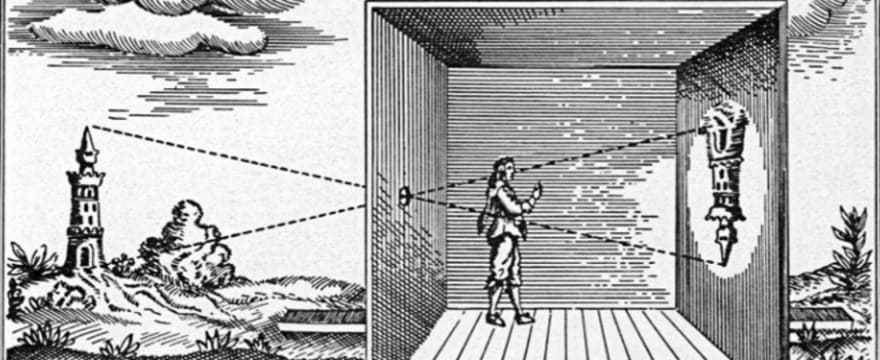
The word "camera" comes from the Latin for room or chamber. Long before anyone fixed an image on paper, people knew that light travelling through a small hole in a darkened room would project an inverted image of the outside world onto the opposite wall. This is the camera obscura — literally "dark room."
The Arabic scholar Ibn al-Haytham (Alhazen), writing in the 11th century, gave the earliest known systematic description of the phenomenon in his Book of Optics. By the 16th century, artists including Leonardo da Vinci were describing portable camera obscura boxes as drawing aids. The device was widely used by landscape and portrait painters to trace accurate outlines — an early form of what we might now call a projection tool.
By the 18th century, compact portable camera obscura boxes with lenses and mirrors were common among artists. The only thing missing was a way to make the projected image permanent. That was the puzzle that consumed a generation of inventors in the early 1800s.
🏛️
Upload as history-photography-camera-obscura
Suggested: illustration or photograph of a camera obscura setup — a darkened box with a projected image on the back wall, or a period engraving.
A portable camera obscura, c. 18th century — the artist traces the projected image to achieve accurate perspective and proportion. The word "camera" comes directly from camera obscura: "dark room."
💡
Artist's tool: The camera obscura's use by Old Masters painters is still debated. Art historian David Hockney argued in his 2001 book Secret Knowledge that many Renaissance and Baroque masters used optical devices to achieve their uncanny accuracy of proportion. The argument remains controversial — but it shows how deep the relationship between optics and image-making goes.
Making a camera obscura image permanent required understanding two things simultaneously: how to coat a surface so light would darken it, and how to then stop the process so the image didn't keep darkening until black. Both proved extraordinarily difficult.
c. 1826
Niépce makes the first permanent photograph
Nicéphore Niépce, a French inventor, coated a pewter plate with bitumen of Judea — a naturally occurring asphalt that hardens when exposed to light — and placed it in a camera obscura pointed at the rooftops outside his upstairs window in Burgundy. After an exposure time of approximately 8 hours, a faint image appeared: the pitched rooftops, a courtyard, and a barn. View from the Window at Le Gras is the world's oldest surviving photograph. It now lives at the Ransom Center, University of Texas at Austin.
1839 — January 7
The daguerreotype is announced to the world
Louis Daguerre, a theatre scenic painter who had been collaborating with Niépce (who died in 1833), announced a new process to the French Academy of Sciences. The daguerreotype used a silver-coated copper plate treated with iodine vapour, exposed in a camera, then developed over heated mercury. The result was a strikingly sharp, one-of-a-kind positive image with no negatives and no copies. The French government immediately bought the rights and made it freely available to the world — hailed as "a gift to all humanity."
1839 — January 31
Fox Talbot announces the calotype
William Henry Fox Talbot, an English polymath, had been working independently and rushed to announce his own process within weeks of Daguerre. His "calotype" (from Greek kalos, beautiful) produced a paper negative that could be contact-printed to make multiple positive copies — the negative/positive system that would define photography for the next 150 years. Talbot's images were softer than daguerreotypes but the concept of a reproducible negative was ultimately far more important.
1839–1860s
Photography spreads worldwide
Within months of the daguerreotype announcement, daguerreotypists were practising on every continent. Portrait studios opened across Europe and North America. The daguerreotype portrait replaced the painted miniature for the middle classes — for the first time in history, ordinary people could have a precise, affordable likeness of themselves and their families.

🪞
Upload as history-photography-daguerreotype
Suggested: a daguerreotype portrait (public domain) — the mirror-like surface, the ornate hinged case, the remarkable clarity. Wikimedia Commons has many excellent examples.
A mid-19th century daguerreotype — each a unique, one-of-a-kind positive image on silver-coated copper, with a mirror-like quality unlike any photographic process before or since. (Public domain)
"From today, painting is dead."— Attributed to the French painter Paul Delaroche, on hearing of the daguerreotype announcement, 1839
The daguerreotype was unparalleled in sharpness but couldn't be copied. Paper calotypes could be printed but were soft. In 1851, English sculptor Frederick Scott Archer published the collodion process, which largely superseded both.
Collodion — a syrupy solution of nitrocellulose in ether and alcohol — was poured onto a glass plate, which was then dipped in silver nitrate to make it light-sensitive. The plate had to be exposed and developed while still wet — within about 10–12 minutes. Photographers had to carry a portable darkroom tent into the field, mixing chemicals on the spot in all conditions.
Despite this extraordinary inconvenience, the wet plate delivered remarkable sharpness, reproducible negatives, and reasonable speed. It dominated photography for three decades and produced some of the most historically important images ever made.
1855–56
Photography in war — Crimea
Roger Fenton travelled to the Crimean War with a horse-drawn darkroom wagon. His 360 photographs of the conflict — careful, posed compositions — were the first large-scale photographic documentation of war. Mathew Brady and Alexander Gardner would do the same in the American Civil War (1861–65) with devastating effect on public consciousness.
1851
Ambrotypes & tintypes
The collodion negative on glass, when underexposed and backed with dark velvet or paint, appeared as a positive image — the ambrotype. On thin iron sheets coated with black lacquer, the same process produced tintypes: cheap, durable, and popular at fairs and markets throughout the second half of the 19th century.
1878
The gelatin dry plate
Richard Leach Maddox discovered that silver halides could be suspended in gelatin rather than collodion — and crucially, the plate remained light-sensitive after drying. This meant plates could be factory-manufactured, purchased ready to use, and developed hours or days after exposure. The mobile darkroom was suddenly obsolete.
1877
Muybridge's galloping horse
Using a series of trip-wired cameras, Eadweard Muybridge photographed a galloping horse in sequence, proving for the first time that all four hooves leave the ground simultaneously. This proto-cinematic experiment laid the groundwork for motion pictures and showed photography's power as a scientific instrument.
⚗️
Upload as history-photography-wet-plate
Suggested: a Civil War-era photograph, ambrotype portrait, or tintype — all public domain and widely available on Wikimedia Commons and the Library of Congress digital archive.
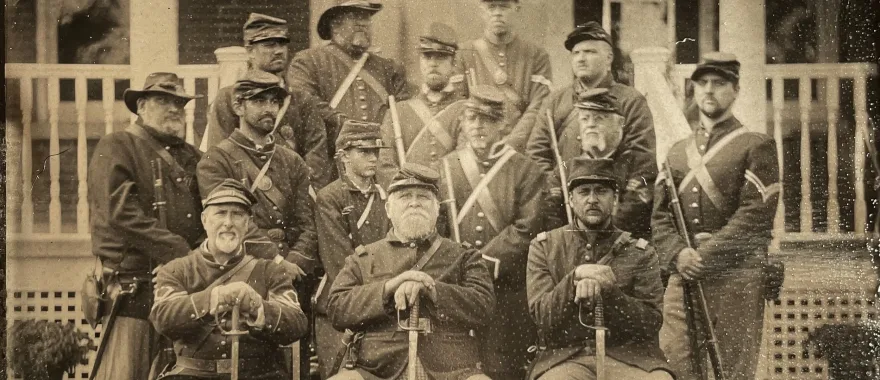
A wet plate collodion photograph, c. 1860s — the process required coating, exposing, and developing a glass plate within 10–12 minutes, all in a portable darkroom. The results were extraordinary. (Public domain)
Glass plates were fragile, heavy, and required professional handling. The shift from plates to flexible roll film is what truly democratised photography — turning it from a professional craft into a mass pastime.
1884–1885
Eastman develops roll film on paper
George Eastman, a bank clerk turned inventor from Rochester, New York, developed a machine for coating gelatin dry plates and then patented a roll holder that fed paper-backed film through a camera. Film could now be made in long continuous strips.
1888
The Kodak No. 1 — "You press the button, we do the rest"
Eastman launched the Kodak camera — a small, fixed-focus, fixed-exposure box loaded with paper roll film for 100 circular exposures. When the roll was finished, you mailed the entire camera to Kodak, who developed the film, printed the photographs, loaded a new roll, and sent it all back for $10. The slogan "You press the button, we do the rest" introduced photography to the general public for the first time. Kodak sold 13,000 cameras in the first year.
1889
Celluloid film replaces paper
Eastman switched from paper backing to a transparent celluloid (nitrocellulose) base, giving clearer negatives and making cinema possible. The same film base — highly flammable nitrate — would also become the medium for Thomas Edison's motion pictures. (Safer acetate film didn't replace nitrate until the 1950s.)
1900
The Kodak Brownie
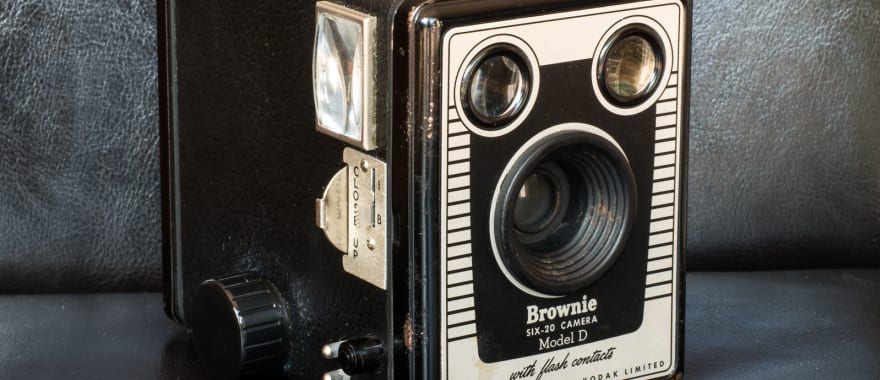
Priced at just $1 (about $35 in today's money), the Brownie was the first camera marketed to children and families. It shot 6 exposures on a No. 117 roll of film. Millions were sold. The Brownie family of cameras continued in production until 1986, spanning 86 years and dozens of models.
📦
Upload as history-photography-kodak
Suggested: an original Kodak Brownie (£1, 1900) or Kodak No.1 camera — both are public domain and in museum collections. George Eastman Museum has excellent press images.
The Kodak Brownie (1900), priced at $1 — the first camera marketed to children and families. It sold millions and put photography in the hands of the general public for the first time. (Public domain)
📸
The Kodak effect: By the early 20th century, the phrase "taking a Kodak" had entered everyday language as a synonym for taking a photograph. Eastman's genius was not just technical but commercial — he understood that the value was in the film, not the camera, and built a business model (razor and blades, 80 years before Gillette was credited with it) around recurring film sales.
Most cameras of the late 19th century were still large — medium-format folding cameras or even glass-plate view cameras. The idea of using the narrow film strips developed for cinema to create a compact still camera was revolutionary. It required lenses that could cover only a small 24×36mm frame — which meant they could be smaller, lighter, and faster than anything before.
1913–1914
Oskar Barnack's "Ur-Leica" prototype
Oskar Barnack, an engineer at the Ernst Leitz optical company in Wetzlar, Germany, suffered from asthma and found large-format cameras exhausting to carry in the field. He built a prototype 35mm still camera — the "Ur-Leica" — for his own use. The concept: double the cinema frame (two cinema frames side by side = the 24×36mm format) to get adequate quality, but keep the camera pocket-sized. World War I delayed commercial development.
1925
The Leica I goes on sale
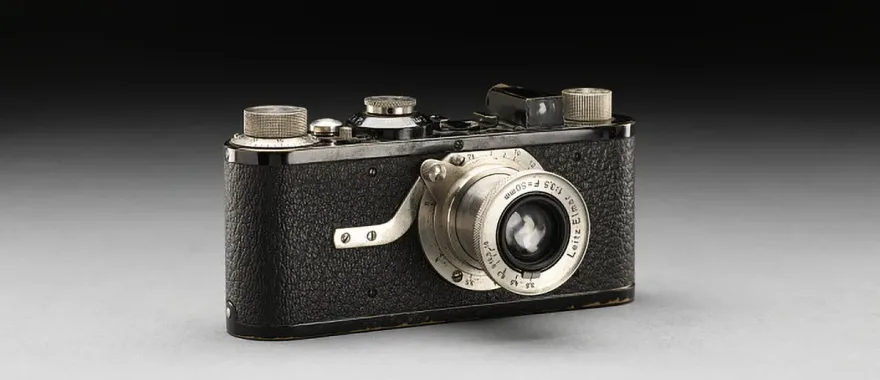
The Leica I was unveiled at the Leipzig Spring Fair in 1925 and became an immediate sensation. It was the first commercially successful 35mm camera — compact, quiet, fast to operate, and capable of producing enlargeable negatives. It came with an f/3.5 Elmar lens, retractable into the body. Within five years it had transformed press photography: photographers could now work in natural light, move freely, and capture unposed moments that large cameras had made impossible.
1932
The Contax & Zeiss enter the scene
Zeiss Ikon launched the Contax, a technically superior rival to the Leica with a longer rangefinder base (more accurate focus), a faster top shutter speed, and interchangeable lenses. The Leica-Contax rivalry drove rapid innovation in optical quality and camera mechanics through the 1930s and 40s.
1936
The first 35mm SLR — the Kine Exakta
German manufacturer Ihagee launched the Kine Exakta, the first single-lens reflex camera using 35mm film. An SLR lets the photographer see through the actual taking lens via a mirror — solving the parallax problem of rangefinders. The design would eventually displace rangefinders as the professional standard over the following two decades.
📷
Upload as history-photography-leica
Suggested: an original Leica I or early Leica M — press images available from Leica Camera AG. Alternatively a street scene shot on Leica showing its character.
The Leica I (1925) — compact, quiet, and capable of making enlargeable negatives from 35mm cinema film. It transformed press photography and established the visual language of documentary and street photography.
From photography's earliest days, practitioners and the public longed for colour. Hand-colouring daguerreotypes and prints was common from the 1840s. But photochemical colour — images that captured the colours of the world automatically — was one of the hardest problems in the history of technology.
1861
Maxwell's colour demonstration
Physicist James Clerk Maxwell demonstrated the first colour photograph — a tartan ribbon photographed through red, green, and blue filters and projected simultaneously. He proved the principle of three-colour photography that underlies every colour process since.
1907
The Autochrome
French brothers Auguste and Louis Lumière (the cinema pioneers) launched the Autochrome, the first commercially successful colour process. Glass plates were coated with a mosaic of dyed potato starch grains in red, green, and blue. The soft, pointillist quality of Autochrome images is distinctive — thousands survive from the Edwardian era.
1935
Kodachrome
Leopold Mannes and Leopold Godowsky Jr. — two musicians turned chemists working at Kodak — developed Kodachrome, the first modern multi-layer colour reversal film. Its richly saturated, highly stable colours became the benchmark for colour photography. The National Geographic magazine adopted it as its house film from the 1930s onwards. Paul Simon wrote a song about it. It was discontinued in 2010.
1942
Kodacolor — colour negative film
Kodak introduced Kodacolor, the first commercially successful colour negative film, allowing colour prints to be made in consumer quantities. Unlike Kodachrome (reversal, for slides and transparencies), colour negative film could be printed at scale — essential for the family snapshot market that would explode in the post-war boom.
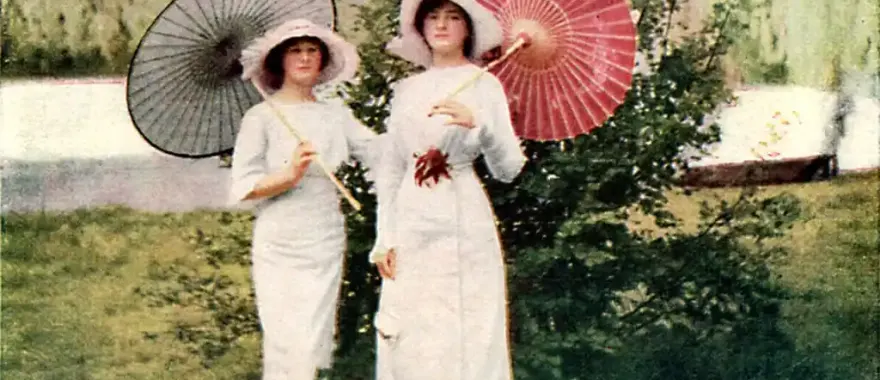
🎨
Upload as history-photography-colour
Suggested: an Autochrome photograph (public domain, many on Wikimedia) — their soft, pointillist colour is unmistakable. Or a Kodachrome slide of a classic American scene.
An Autochrome photograph, c. 1910 — made from dyed potato starch grains on a glass plate, the first commercial colour process gave images a soft, pointillist quality unlike anything that followed. (Public domain)
🎨
Colour vs. black & white in photojournalism: Well into the 1970s, most serious newspaper and magazine photography was shot in black & white — partly because colour printing was expensive and technically difficult, and partly because B&W was seen as more "journalistic." The shift to colour news photography happened gradually from the mid-1970s as colour reproduction costs fell. Today, almost all press photography is colour; B&W is used as a deliberate aesthetic choice.
The post-war period saw the 35mm SLR evolve from a specialist instrument into the dominant camera for professional and serious amateur photography. Pentaprism viewfinders (allowing eye-level viewing), TTL metering (measuring light through the lens), and ever-faster film and lenses combined to make photography more capable than ever — and more portable.
1947
Polaroid instant photography
Edwin Land, founder of Polaroid, demonstrated a camera that could produce a developed print in 60 seconds. By placing the developing chemistry inside the film pack, Land eliminated the need for a darkroom entirely. The Polaroid Model 95 launched in 1948. A series of increasingly sophisticated Polaroid cameras followed, culminating in the SX-70 (1972), which ejected self-developing colour prints automatically and remains one of the most beautiful camera designs ever made.
1959
The Nikon F — a professional system is born
Nikon launched the Nikon F, a fully system SLR with interchangeable finders, motor drives, and an extraordinary range of F-mount lenses. It became the camera of choice for photojournalists covering Vietnam, civil rights, the Apollo programme, and virtually every major news event of the 1960s. Life Magazine photographers adopted it almost wholesale. The Nikon F-mount — with minor updates — remained in production until 2020, a 61-year run.
1959–1972
Canon, Minolta, Olympus enter the market
Japan's camera industry — suppressed during the war — surged to global dominance in the 1960s. Canon with its FX/FT series, Minolta with the SR-T family, Pentax with the Spotmatic, and Olympus with the OM-1 all released highly capable, competitive SLRs. The quality of Japanese optics matched and then surpassed German alternatives at lower prices — devastating the West German camera industry.
1968–1975
Photography on the Moon
The Apollo programme used Hasselblad 500EL cameras with Zeiss lenses for almost all surface photography. Because there was no way to bring the cameras back, the astronauts left the camera bodies on the lunar surface and returned only the film magazines. These images — taken by non-photographers following simple exposure protocols — remain among the most iconic ever made. Hasselblad has been supplying NASA ever since.
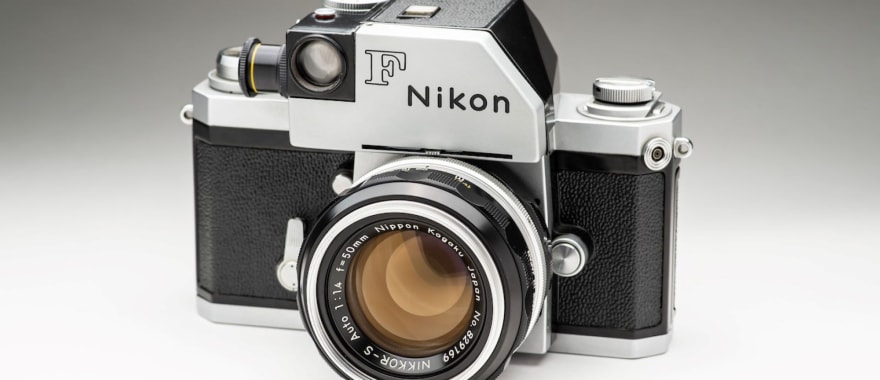
📸
Upload as history-photography-slr-era
Suggested: Nikon F camera (press/museum image), or a documentary photograph of photojournalists working — Life Magazine era aesthetic.
The Nikon F (1959) — adopted almost wholesale by photojournalists covering Vietnam, civil rights, and the Apollo programme. Its F-mount lens system remained in production for 61 years.
The great photojournalists
Henri Cartier-Bresson
1930s–1970s
Co-founder of Magnum Photos. Shot exclusively with a Leica, often with a 50mm lens. Developed the concept of the "decisive moment" — the instant when form, content and meaning converge in a single frame. His 1952 book of the same name is one of the most influential in the medium's history.
Robert Capa
1930s–1954
Born Endre Friedmann in Hungary. Covered five wars including the Spanish Civil War and D-Day. His blurred, kinetic photograph of a falling Republican soldier (1936) remains the most debated image in photography. Died stepping on a landmine in Indochina in 1954. Co-founder of Magnum Photos.
Dorothea Lange
1930s–1960s
Working for the Farm Security Administration during the Depression, Lange's Migrant Mother (1936) became the defining image of the era. Her documentary approach — approaching subjects with dignity, letting them be seen — established a template for socially conscious photography.
Ansel Adams
1920s–1980s
The master of the American landscape. Shot on large-format film with extraordinary technical precision, developing the Zone System — a method for systematically relating exposure to print density. His photographs of Yosemite and the American West defined how a generation imagined wilderness.
Diane Arbus
1950s–1971
Arbus photographed people on the margins — nudists, transvestites, circus performers, the disabled — with a directness and intimacy that was unprecedented. Her twin Rolleiflexes (shooting square medium format) and use of flash in daylight gave her work a charged, confrontational quality.
Nick Ut
1972
Associated Press photographer whose 1972 photograph of nine-year-old Kim Phúc fleeing a napalm attack in Vietnam won the Pulitzer Prize and is credited with shifting American public opinion against the war. A single photograph's capacity to change history.
The 1970s brought two developments that pushed photography further into everyday life: fully automatic exposure control and, eventually, autofocus. Together they removed the last technical barriers between a non-photographer and a correctly exposed, in-focus image.
1976
The Canon AE-1
The Canon AE-1 was the first camera to use a microprocessor, enabling fully shutter-priority automatic exposure at a consumer price point. An enormous marketing campaign — including television advertising, an extreme novelty at the time — made "Canon AE-1" a household name. It sold over five million units and brought the SLR to a mass audience for the first time.
1977
The first autofocus camera — Konica C35 AF
The Konica C35 AF was the world's first mass-produced autofocus camera — a compact 35mm point-and-shoot that used an active infrared system to measure distance and set focus automatically. Honeywell's Visitronic module did the work. Within a decade, autofocus had migrated to professional SLRs. The Minolta Maxxum 7000 (1985) was the first AF SLR system — integrated AF motor in the body — and precipitated Canon's decision to abandon the FD lens mount and develop the entirely new EF system in 1987.
1982–1995
The point-and-shoot golden age
A generation of compact 35mm cameras with good quality fixed or zoom lenses, autofocus, and automatic flash made photography entirely passive. The Olympus Stylus (MJU), Nikon L35AF, Canon Sure Shot, and Fujifilm DL Super Mini are now among the most sought-after cameras on the used market. They were the cameras of family albums, holidays, and parties through the 80s and 90s — and their images define the visual memory of that era.
1986
Fujifilm disposable cameras
Fujifilm launched the QuickSnap, the first modern disposable (single-use) camera. Sold pre-loaded with film and with a fixed exposure, the user returned the entire camera for processing. They became ubiquitous at weddings, parties, and holidays — and are now experiencing a revival as an aesthetic choice.
The shift from silver halide film to digital image sensors is the most disruptive change in photography's history — more fundamental than the move from plates to roll film, because it changed not just the medium but the entire economics and culture of the craft.
1975
Sasson invents the digital camera — at Kodak
Steve Sasson, a 24-year-old electrical engineer at Kodak, built the first digital camera in 1975 from a kit of parts including a CCD from Fairchild Semiconductor. It was the size of a toaster, weighed 3.6kg, took 23 seconds to capture a 0.01 megapixel image to a cassette tape, and displayed it on a television. Kodak's management, seeing the threat to their film business, shelved it. This decision is now studied in business schools as a textbook case of innovator's dilemma.
1991
The first commercial digital camera — Kodak DCS 100
The Kodak DCS 100 — a Nikon F3 body modified with a 1.3-megapixel CCD sensor and a separate hard drive unit worn over the shoulder — cost $13,000 and was sold to photojournalists. It was impractical and expensive, but it proved the concept. AP and Reuters photographers began using it for sports events where speed of transmission mattered more than image quality.
1994–1999
Consumer digital cameras arrive
The Apple QuickTake 100 (1994) was the first consumer digital camera, followed by the Casio QV-10 (first with an LCD screen, 1995) and the Kodak DC series. All had very limited resolution (0.3–1 megapixel) and poor image quality. The Nikon D1 (1999) — 2.7 megapixels, $5,500 — was the first professional DSLR and the point at which photojournalists began seriously switching from film.
2003
Digital goes consumer — Canon Digital Rebel (300D)
The Canon EOS 300D (Digital Rebel in North America) launched at $999 and brought 6-megapixel digital SLR photography to the mass market for the first time. Film camera sales collapsed almost immediately — Nikon stopped making consumer film cameras in 2006. Kodak filed for bankruptcy in 2012, unable to transform its film-based business model fast enough despite having invented digital photography.
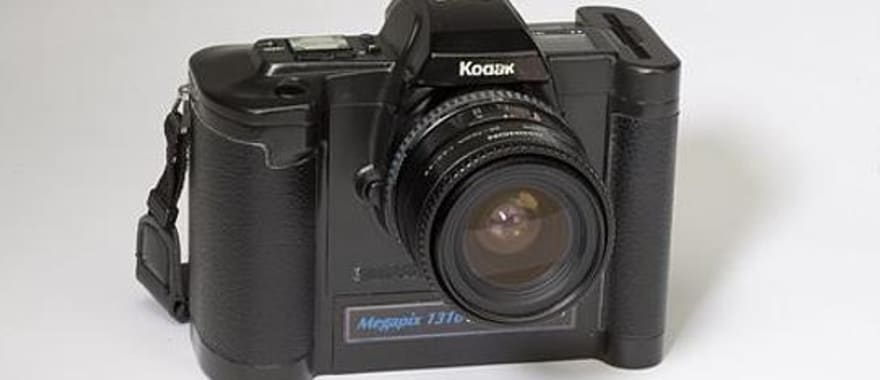
💾
Upload as history-photography-digital
Suggested: early Nikon D1 (1999), Canon EOS D30 or 300D, or Kodak DCS — showing the bulky early digital body alongside a CF card.
The Canon EOS 300D (Digital Rebel), launched in 2003 at $999 — the camera that brought 6-megapixel DSLR photography to the mass market and triggered the collapse of consumer film camera sales.
"We developed the technology, then sat on it and did nothing with it. And in the meantime, the Japanese ate our lunch."— Steve Sasson (Kodak engineer who built the first digital camera), on Kodak's failure to commercialise the technology
📉
Kodak's fall: Kodak at its peak (1976) held 90% of US film sales and 85% of camera sales. In 2012, it filed for Chapter 11 bankruptcy with $6.8 billion in liabilities. The company that had invented digital photography, built the first digital camera, and even produced early digital camera sensors was destroyed by its inability to cannibalise its own film business. It has since restructured as a printing and imaging company, but the Kodak story remains one of the most studied corporate failures in modern business history.
If digital cameras disrupted film photography, smartphones disrupted digital cameras even more thoroughly. The best-selling cameras today are not Sony or Canon — they are the iPhone, Samsung Galaxy, and Google Pixel. In 2023, an estimated 1.4 trillion photographs were taken worldwide — more in a single day than in all of photography's first 150 years combined.
2007
The original iPhone
The first iPhone had a 2-megapixel fixed-focus camera with no video. Steve Jobs barely mentioned the camera in his keynote. Within five years, the iPhone camera had become the most-used camera in the world on Flickr. By 2012, the iPhone 4S's 8-megapixel camera was good enough for magazine photography, and the phrase "the best camera is the one you have with you" entered common usage.
2010
Instagram launches
Instagram — launched in October 2010, acquired by Facebook for $1 billion in 2012 — fundamentally changed how photographs were shared and consumed. Its filters mimicked the lo-fi aesthetic of compact film cameras and lent a warm, nostalgic look to phone snapshots. Instagram also created a new class of "photographer" — the influencer — and a new form of visual communication built around the curated feed. By 2021, over 100 billion photos had been uploaded to the platform.
2016–present
Computational photography
Modern smartphone cameras use computational photography — machine learning algorithms that composite multiple exposures, simulate optical bokeh, apply AI-based noise reduction, and HDR-map images in real time. Google's Night Sight (2018) could produce sharp, bright images in near-darkness that no traditional camera could match. The boundary between photography and digital illustration is increasingly blurred: the "camera" is now as much software as hardware.
2012–present
The analog film revival
Against all expectations, analog film has been growing every year since around 2012. Kodak relaunched Ektachrome in 2018 after discontinuing it in 2012. Ilford has expanded production. Used film cameras regularly sell for multiples of their original price. The demographic driving the revival is young — people who grew up with digital, discovering film as something new, tactile, and deliberately slow. The revival is not nostalgic for most practitioners; it's a choice made in full knowledge of the digital alternative.
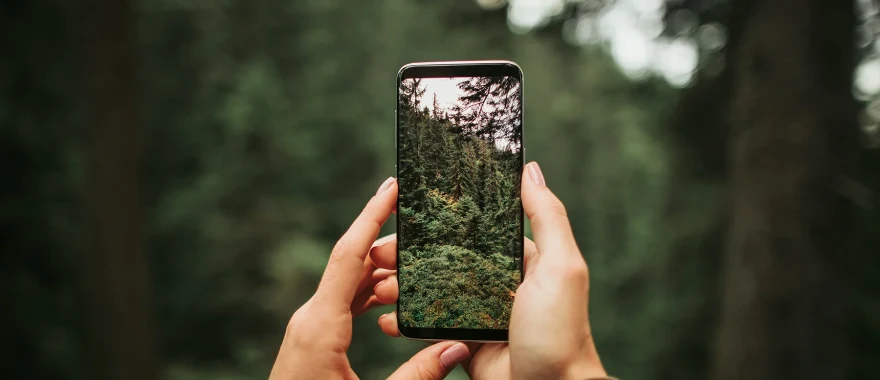
📱
Upload as history-photography-smartphone
Suggested: someone photographing with a phone — a street scene, food, a crowd. The contrast between the tiny device and the scale of its cultural impact is the story.
1.4 trillion photographs were taken in 2023 — more in a single day than in all of photography's first 150 years combined. The overwhelming majority were taken on smartphones.
📽️
AI and the future: In 2023, AI-generated imagery — tools like Midjourney, DALL-E, and Stable Diffusion — began producing photorealistic images from text prompts. This raises questions that have echoed through photography's entire history: what is a photograph? What is truth in an image? How does technology change what we mean by "seeing"? Photography has always been more than a record of reality — it has been a negotiation between the world, the photographer, and the medium. That negotiation continues.
← Back to all guides